Museveni: Special Forces Command created for Uganda, not Muhoozi
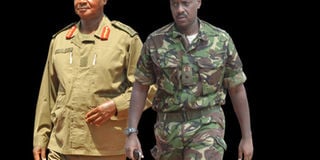
A photo montage of President Museveni and his son Muhoozi.
What you need to know:
A battle for youth. The President accuses Kizza Besigye of misleading Ugandans on SFC, initially formed as High Command Unit in 1981 when Muhoozi was just seven years old.
Last week, I disposed of the bulk of Dr. Besigye’s lies. I promised the readers that in another piece, I would deal with the remaining lies or distortions. These were: “Special Forces was created for Muhoozi”; “Poverty”; “We went to the bush to overthrow Army rule”; and “Power belongs to the people and not Army rule”.
What is now Special Forces Command was founded in May 1981, at Kyererezi, in Kapeeka, before Dr. Besigye joined the struggle and when Muhoozi was just seven years old.
We had launched our struggle on the 6th of February, 1981, by attacking Kabamba with just 27 rifles. Through ambushes (e.g. Kawanda), subsequent attacks on UNLA (e.g. Kakiri, on the 6th of April), removing guns from Police Stations (e.g. Isunga, Kasanda, Busunju, Bukuya, Bukwiri, Kiboga, etc.), we had about 60 rifles by May, 1981.
Meanwhile, recruits were flocking into the Resistance Army. The number was now 200 people; at Kabamba we had been about 40 people but with only 27 rifles.
Creation of Special Force Command
Since we were still operating in concealment, I decided to create Units by breaking up the 200 people because 200 people moving in one group are not easy to conceal. Accordingly, we created the following Units: Abdul Nasser (Matugga area) with 43 rifles; Mondlane (Makulubita area); Kabaleega (Kapeeka area); Nkrumah (Bukomero-Lukoola-Kyankwanzi area); and one Section to always travel with the Chairman of the High Command (CHC) – Yoweri Museveni.
Since Abdul Nassar took 43 rifles out of 60, the rest of the Units shared the remaining 17 rifles. Other Units such as Lutta, Ngoma and Mwanga were created later. So was the decisive Mobile Force.
Since we had now created Zonal Units, instead of having only one nomadic (roving) unit, it necessitated the CHC to always travel to visit these units. In order not to divert manpower from the Zonal Units to escort and guard the CHC, it was better to have a small Force dedicated to guarding him.
Whenever I decided to walk to any point, we would move straight away without waiting to raise an escort Force from the Zonal Forces. That is how what is now Special Forces group started. Initially, it was like a Section (12 people), if my memory serves me right. By the end of the war (1986), it was a Company size (120-140 people).
Lack of written records because of the circumstances of that time forces me to rely on my memory. I think, by this time, it was being called “the High Command Unit”. When we captured power, it became the Presidential Protection Unit (PPU) equivalent to a battalion size (700-800 soldiers).
With the new challenges of fighting the counter-revolutionary forces (terrorists, hostile neighbours, etc), the PPU soon expanded into a Brigade (three battalions or more) with added responsibilities of not just protecting the President but also guarding the whole country in some aspects, sharing that responsibility with the rest of the Defence Forces and also participating in counter-insurgency and counter-terrorism operations, on the express orders of the President.
Achievements
I remember, for instance, one example, during the Kony terrorism in the North. The Kony groups had got some anti-tank cannons known as B-10s (82 mm recoilless guns). There was one audacious gunner who managed to damage some of our mambas.
I decided to help the Forces in operation by deploying a Force from Presidential Guard Brigade (PGB), which had been rehearsing anti-ambush drills.
They caught up with this gunner at Barlegi Primary School (deserted at that time and very bushy), killed him and recovered the recoilless gun.
When the ADF infiltrated Uganda from Congo the last time (I think, it was 2006), they entered the Semliki National Park. A Commando Force from PGB was dispatched to counter this threat. Working with the 2nd Division Units in the area, the ADF group was almost wiped out.
Out of the 100 terrorists that had infiltrated, about 83 of them were killed. Only 13 terrorists went back to Congo. During the recent operations in Mogadishu, special elements from the Special Forces Command (both marine and commando) played crucial roles in defeating the Al-Shabaab alongside the bigger Uganda Expeditionary Force in Somalia.
Therefore, what was originally the CHC’s escort, High Command Unit, then later, Presidential Protection Unit, Presidential Guard Brigade and now the Special Forces Command has, over the course of many years, graduated from a V.I.P. Protection Force into a crucial component of the strategic defence structure of the country alongside the Reserve Forces Command, etc.
It is part of the capacity that can re-inforce the other Divisions in case of need. It is only people who do not wish Uganda well that can be unhappy with such a Force.
The first Section Commander of this Force must have been the late Robert Kabuula, then the late Akanga Byaruhanga (when he came from Luzira), Geoffrey Muheesi, then, George Mayeku, Dick Bugingo, Leo Kyanda, William Bainomugisha and, now, Muhoozi Kainerugaba.
Many other officers who have been in the PGB- Special Forces branch are now out and they play big roles in the bigger Force - UPDF. People like Aronda Nyakairima, Geoffrey Muheesi, Sam Kavuma, Dick Olum, Robert Ochama, etc. have served for long periods in the PGB as it was called then.
Even in recent times, PGB/Special Forces Command, was still playing its original role of enabling the CHC (now Commander-in Chief) to go to any dangerous part of Uganda at a moment’s notice without disturbing the Zonal or Sector Forces requesting for escorts and protection.
On the contrary, the CHC (Chairman of High the Command/Commander-in-Chief), with the PGB, would come to an operational area (e.g. Gulu, Barlegi, Soroti, Karamoja, the Rwenzori Region) not as a burden to the Sector Forces of that area but as a welcome re-inforcement.
When Vincent Otti, aided by the mendacious and hostile press, was making a fool of himself threatening Gulu town, I arrived there with a sample package of the PGB. We relieved the 4th Division of the sole burden of defending Gulu barracks and Gulu town.
Some panicky individuals suggested that we should switch off the lights in Gulu barracks so that Vincent Otti does not see where we were. I rejected the idea. Otti’s offensive against Gulu ended up with three mortar shells, one falling into a garden of potatoes near the barracks and a group of terrorists near Lalia Primary School that were dispersed by our tanks. That was the end of the ‘battle’ for Gulu town.
I am very happy with the role of the Special Forces Command and of the entire UPDF with their different but complimentary lubimbis (roles, assignments) or, more correctly, mimbi’s (plural).
Therefore, the Special Forces Command evolved long before Besigye joined NRA and when Muhoozi Kainerugaba was only seven years old. It was not created for Muhoozi. It was created for the Resistance struggle and for Uganda.
Poverty alleviation
Then, Dr. Besigye talked of “Poverty”. In terms of statistics, Poverty has actually gone down. While the people below the Poverty line were 56% in 1992, they are now averaging at 24.5%, if you take the country as a whole. If you go Region by Region, the figures are; Central 10.7%, Western 21.8%, Eastern 24.3% and Northern 46.3%.
You all know why the figures for the Northern Region are still bad. It is because of the prolonged terrorism, which was either applauded or supported by elements of the Opposition to which Dr. Besigye chose to belong.
The NRM, the UPDF and the people stood firm until we defeated the insurgency (terrorism) and disarmed the Karimojong cattle-rustlers all by ourselves, with some goodwill from a few elements of the Opposition.
When, however, we say that somebody is above the Poverty line, we mean that he/she has access to food which, in terms of calories, is above or equal to what an ordinary person of that age requires to carry on normal daily activities.
That person also has access to basic services like education, health and safe water, since the NRM Government is providing some of these services (free education, health, etc). That is why the population has exploded from 14 million people in 1986 to 35 million people today.
However, having enough calorie intake, accessing education, health and safe water, solves only a part of the human problems. There is the problem of moneylessness, lack of jobs, etc, that are still a big problem for our people.
Somebody who is not engaged in any income generating activity will not have money. Without money, even if you have food, you still will not build a good house, clothe your family and do other family requirements. That means you are poor in terms of money.
Lack of jobs also creates ‘money poverty’ even if people have access to food, health care and are, therefore, technically above the Poverty line.
Which groups have kept our people in this situation of moneylessness? The Opposition groups have played a role in diverting our people’s attention from this issue to their own quest for power. The radios also play a role in this obscurantism – diverting people from their real interests to the interests of others.
Our economy has got five activities in which one can engage: agriculture; industry; services; public service; and ICT. It should be the duty of all responsible leaders, radios, church leaders, cultural leaders, etc., to advise our people at any available occasion as to how each person can fit himself/herself in any of these sectors.
Agriculture
Those who are educated or enlightened make money from agriculture (commercial agriculture). A big section of the peasants are, however, still stuck in subsistence farminggrowing food but no activities for money. I had started working on sensitising the peasants in the Nyabushozi area in the 1960s on this very issue. When we came from the bush, I developed this work.
By 1995, I had proved that peasants can transition from subsistence farming to commercial agriculture. I made a countrywide tour sensitising the population about this. Unfortunately, many political leaders, on both NRM and Opposition side, find a lot of difficulty in grasping this issue.
Many leaders talk of roads, schools, hospitals, piped water, electricity, etc. They, however, do not talk of wealth creation at the household level, which, in the case of agriculture, revolves around moving from subsistence to commercial farming and correct enterprise selection.
Where this has been accepted, rural poverty is definitely tackled. The examples are Kiruhuura, Bundibugyo, some parts of Kabarole (for tea growing), some parts of Kanungu (for tea growing), some parts of Sebei (for Arabica coffee, wheat and dairy farming), some individuals in Kabaale (growing apples, pineapples), in Teso (for growing citrus fruits), etc.
In some of these areas, people who have generated incomes have built modern houses, have solar panels on the roofs of their houses, have bought personal cars, are sponsoring students privately in universities, etc.
In our 1996 Manifesto, we talked of a four-acres plan for each homestead. One acre for clonal coffee, one acre for bananas, one acre for elephant grass (ebisagazi, ebibingo, etc) for zero-grazing cattle and one acre for fruits (oranges, mangoes, pineapples or apples according to the locality).
On top of these crops and dairy cattle, there should be five additional activities that use less space that can be added on, like poultry farming, rearing pigs as well as improved goats in the backyard of the homestead and fish farming (near the swamps) where applicable as well as apiary (bees) if there is space.
In the peri-urban areas, you can add mushroom growing. Ms. Kizza of Masaka, people like Mudusu in Kasese and Nyombi of Mityana, are some of the best examples of model farmers.
Industrialisation
The other therapy for Poverty alleviation is the cottage industries such as winemaking using bananas (in Sheema district) as well as using grapes (Nyakayojo in Rwampara and Mukono districts), etc.; and handlooms (Mukono district, Kalongo area in Acholi region, etc).
The mega therapy for poverty, however, is industrialisation. That is how modern economies are organised. This has been the position of NRM as Dr. Besigye pointed out in his article. The NRM, however, has faced opposition from many corners. Opposition to electricity projects which are inputs to industries or to the factories themselves.
The groups that sabotage such projects and then turn round and pretend to be concerned about Poverty are either not sincere or confused. Shifting to industries instead of just relying on agriculture is the ultimate way to go.
Even the Western countries that had been misled by some of the elements to neglect industries and talk of “post-industrial” economies (meaning economies just based on services and financial speculation) have discovered their mistakes and are trying to retrace their steps.
Yet, here, you have an economy that has got very good chances to industrialise, having its chances thwarted by either malicious actors or mistake makers who cannot be advised.
Free education
The other ingredients for Poverty therapy have already been put in place: Education for all and Health (especially immunisation). Dr. Besigye was among those attacking UPE (Bonna Basome), calling it “Bonna Bakone.” Unfortunately for Dr. Besigye, the situation on the ground gives a different story as I pointed out in my previous article.
Nearly 600,000 children sat for Primary Leaving Examination (P.L.E.) last year. About 300,000 students sat for S.4 last year. Some of the districts like Yumbe have only UPE and USE (Universal Secondary Education) schools. If those schools were not there, there wouldn’t be much education in those districts.
I am very proud that the NRM, as soon as we had some little money in 1996, started UPE, added USE (later), added BTVET (Business, Technical, Vocational Education and Training), added free A-level education and we are now looking at the Students Loan Scheme for the University students. Education and health are some of the components in the anti-Poverty war.
Another of Dr. Besigye’s distortions was that we went to the bush to fight Army rule. Dr. Besigye, we went to the bush to fight three evils: lack of democracy (rigging elections in which FDC excels as I will prove in another article), extra-judicial killings and arbitrary arrests (outside the law). Whether violations of people’s fundamental rights were done by Police, Intelligence services, UPC Youth wingers or the Army, it made no difference.
The summary for all this would be criminalised governance. The Army, the NRA, as Dr. Besigye would surely remember, was in fact the vanguard of the people’s struggle for these fundamental rights.
Even today, the UPDF has been not only the vanguard of the people’s struggle for peace but has also been the most disciplined Force in the country – incomparably disciplined vis-à-vis elements of the political class, for instance. FRONASA, the NRA and now the UPDF always act with the people, never against the people.
That is why the recent circus about a “coup” manufactured by the Daily Monitor newspaper and amplified by individuals in the habit of weaving schemes in the NRM was nothing but nonsense.
The Revolutionary Armies of Uganda always act against the killers, the Constitution violators, the parasites as well as other wrong doers and always do so with the support of the bulk of the population.
That was the case in the past, it is the case now and it will be the case in the future. Therefore, Besigye’s ideas about the people fighting the Army and the Army fighting the people are wrong.
It seems Besigye did not give himself enough time to understand the FRONASA/NRA/UPDF. I could detect that in the serialised articles he put in the papers some time ago.
People’s army
Finally, he said: “power belongs to the people and not the Army”. Yes, Dr. Besigye but the Army is part of the people. The people cannot be without an Army. If you have never seen a people without an Army, look at Somalia, look at Mali and some of the other countries.
If you have forgotten about a people with a bad Army, remember Uganda Army (UA), UNLA, etc. What we fought against and destroyed were anti-people Armies (killing, raping, looting, etc). When we detect any anti-people behaviour in the NRA/UPDF, we act harshly against those involved.
That is why we have executed by firing squad 22 soldiers in the past 27 years of NRM’s leadership of the country. A pro-people Army, a patriotic Army, always acts with the people and never against them.
I have used Dr. Besigye’s interview to clarify some lies that have been peddled around for sometime mainly for the benefit of the young people who did not see the bad times Uganda went through. In future, I may not respond to all the distortions put out by Dr. Besigye or his colleagues unless there is something fundamentally different that they bring out.
I thank the Editor.