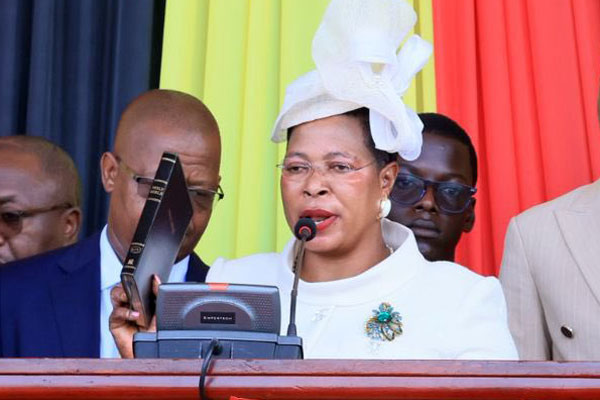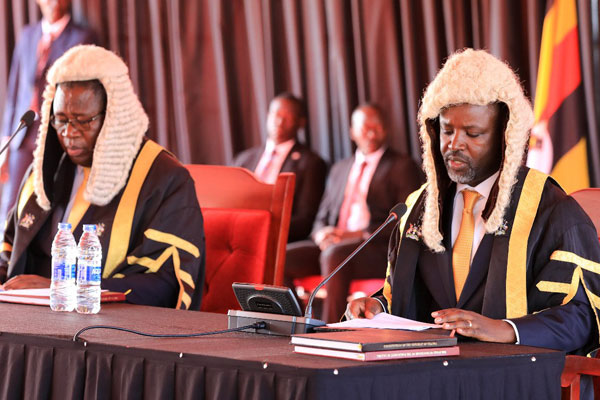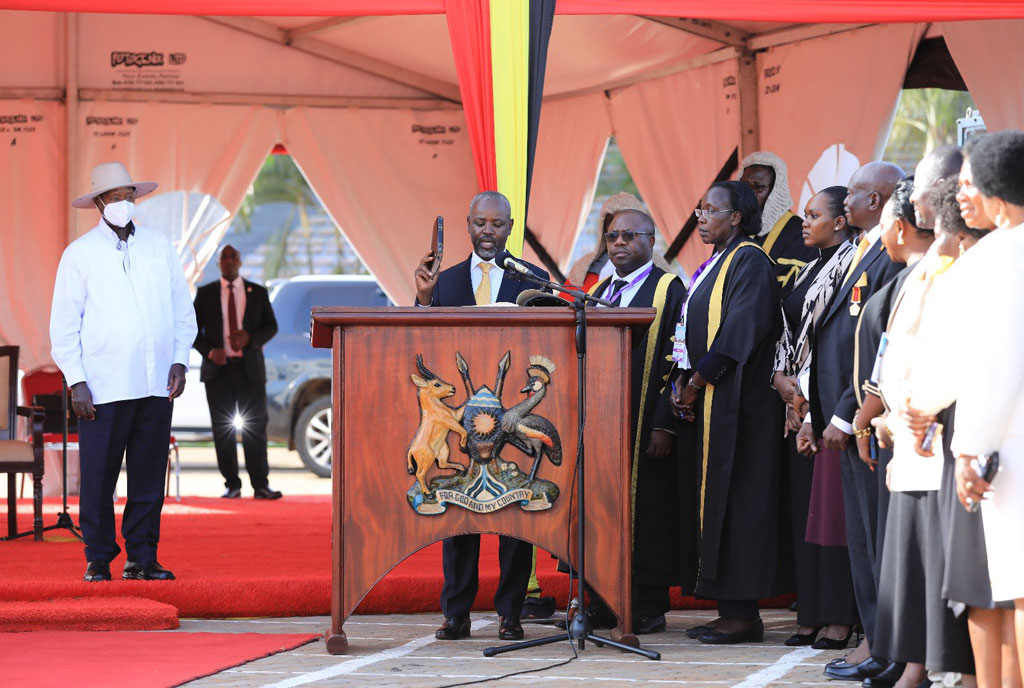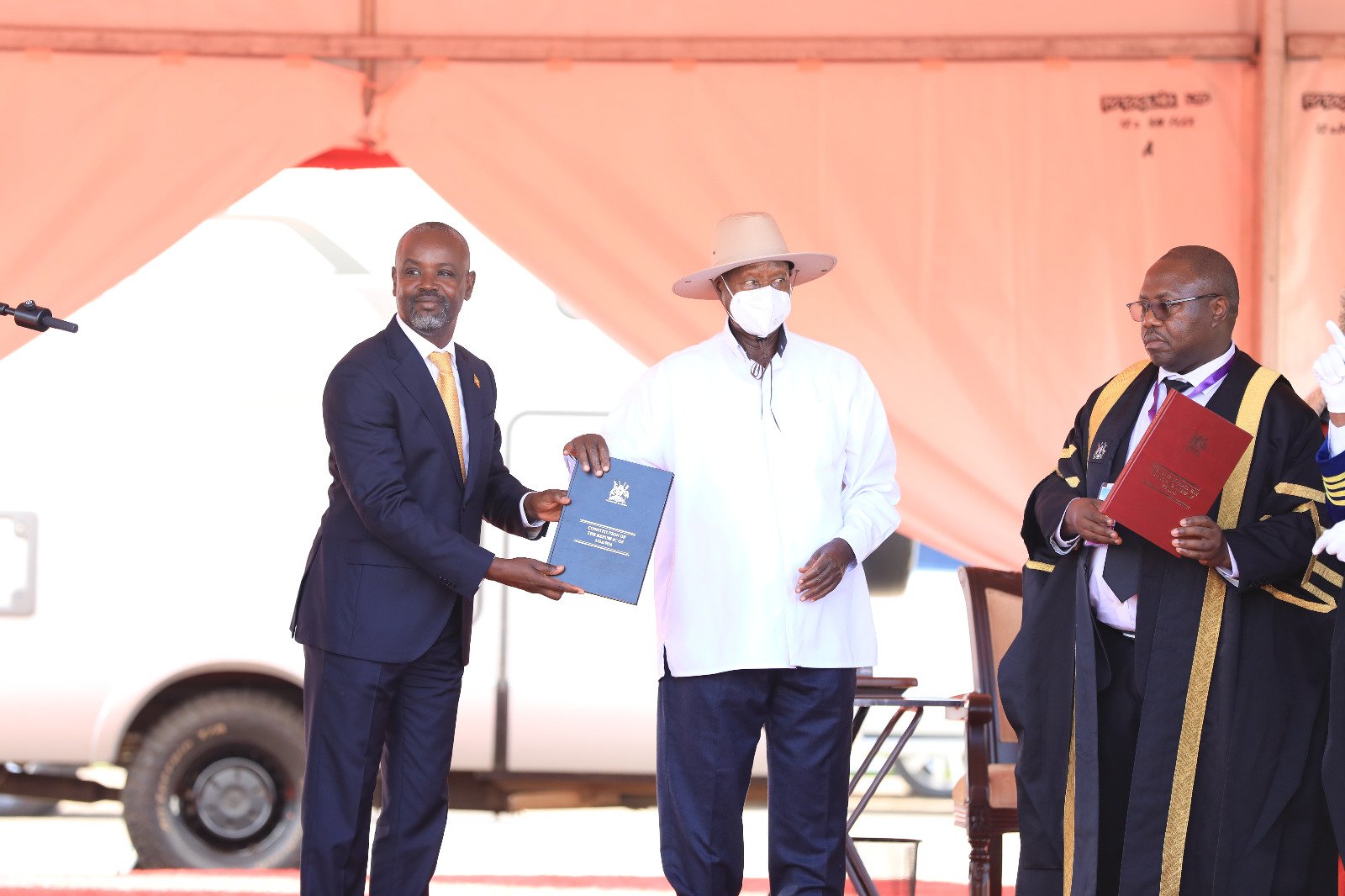
President Museveni (C) symbolically hands a copy of Uganda's Constitution to the Deputy Speaker of the 12th Parliament, Thomas Tayebwa (L) as the Clerk to Parliament Adolf Mwesige Kasaija (R) looks on during the election of new parliamentary leadership on May 25, 2026. PHOTO/LIAMENT ON X
In the high-stakes theater of Ugandan politics, names often carry the weight of destiny. For Thomas Tayebwa, whose surname translates to "one who never forgets," memory and strategy have served as the twin pillars of a meteoric political ascent.
By maintaining a calculatedly simple approach to a complex political landscape, the lawmaker from the rolling hills of Mitooma District has successfully navigated the treacherous waters of partisan shifts, internal party rivalries, and institutional power struggles.
Yesterday, that journey culminated in a definitive victory. Following clearance from the internal organs of the ruling National Resistance Movement (NRM), Tayebwa secured a landslide election as the Deputy Speaker of the 12th Parliament.
The lopsided final tally reflected both his immense popularity within the legislative house and the formidable mobilization machinery of the ruling party. Tayebwa garnered an overwhelming 457 votes, leaving his challengers stranded in the single and double digits. Ms. Asinansi Nyakato, the Hoima City Woman MP representing the newly formed opposition faction, the People’s Front for Freedom (PFF), managed just 45 votes. Meanwhile, Sarah Aguti, the Uganda People’s Congress (UPC) representative for Dokolo District, finished a distant third with 14 votes.
The metallic suitcase and the Makerere turning point
To understand Tayebwa’s political trajectory requires examining the carefully curated narrative of his humble origins—a backstory he frequently invokes to inspire the country's swelling youth demographic.
Born on November 10, 1980, to Daudi Bangirana and Betty Komuhangi in the remote village of Bitereko, in what is now Mitooma District, Tayebwa's early life followed the standard script of rural peasantry. He attended Kigarama Primary School, advanced to Kigarama Senior Secondary School, and completed his Uganda Advanced Certificate of Education (UACE) at Ruyonza School in 2000.
The definitive turning point came at the turn of the millennium when he traveled to the capital to join the nation's premier tertiary institution.
“I arrived at Makerere University in 2001 with a metallic suitcase and Shs450,000 in fees,” Tayebwa recalled during an address to Makerere University students in August 2023. “I came to Makerere with no relatives in the government, but today, I am Deputy Speaker of Parliament. I might have been the son of a peasant, but I am no longer a peasant, and my children will never be peasants.”
At Makerere, Tayebwa did more than study; he built a network of friends and allies that would later insulate him from political pitfalls. He graduated with a Bachelor of Arts in Social Sciences in 2005, later returning to complete a Bachelor of Laws (LLB) in 2012, professionalizing a legal acumen that would sharpen his legislative capabilities.
The strategic shift: From FDC card No. 12 to NRM power broker
Tayebwa’s entry into national politics was marked by an ideological flexibility that critics call opportunism, but supporters label pragmatism. He initially emerged from the ranks of the opposition, serving as one of the founding members of the Forum for Democratic Change (FDC). Holding FDC party card number 12, he was a vocal, high-energy mobilizer in Western Uganda—a region traditionally considered an unassailable stronghold for President Yoweri Museveni's NRM.
However, Tayebwa soon grew disillusioned with the structural limitations of permanent opposition.
“In FDC, we had a very big fan base, but it wasn’t growing,” Tayebwa explained to reporters following his election victories. “My argument was simple: unless we cut into the base of NRM, then we wouldn’t be able to achieve power. I was like, look, I am not here to be a career opposition leader; I am here to enter a party and go to power.”
Acting on this realization, Tayebwa temporarily stepped away from frontline politics to venture into the private sector, all while maintaining close personal ties with influential NRM figures. When the political calculus aligned, he crossed the aisle—a move he colloquially describes as "seeing the light."
The NRM’s acquisition of Tayebwa was viewed as a major blow to the opposition's western infrastructure. Utilizing his newfound ruling-party credentials, Tayebwa contested and won the parliamentary seat for Ruhinda North, a constituency he has firmly locked down ever since. During his initial years in the August House, he served diligently on the parliamentary committees of National Economy and Natural Resources, quietly mastering the internal mechanics of the legislature.
Navigating the Speakership storm
The path to the Deputy Speaker's chair was neither linear nor uncontested. When Tayebwa secured his renewed parliamentary mandate for Ruhinda North, he openly declared his ambitions for the deputy speakership. This set him on a direct collision course with another ambitious former opposition member turned NRM stalwart: Ms. Anita Among, the Bukedea District Woman MP.
The internal NRM race quickly fractured into intense factionalism, compounding an already volatile battle for the top Speaker position between the veteran incumbent, Ms. Rebecca Kadaga, and her then-deputy, Jacob Oulanyah.
Political alliances formed rapidly. Kadaga, seeking to extend her decade-long tenure as Speaker, joined forces with Tayebwa. This camp stood in direct opposition to the Oulanyah-Among axis.
The internal friction forced the intervention of the NRM’s highest organ, the Central Executive Committee (CEC). The names of Tayebwa, Among, and Robinah Rwakojo were forwarded to the NRM Parliamentary Caucus to vote on an official flagbearer. In a fiercely contested caucus vote, Tayebwa narrowly lost, polling 149 votes against Among’s 168.
Refusing to back down initially, Kadaga and Tayebwa defied the caucus consensus and chose to run as independent candidates in the general parliamentary election. The move prompted a direct, behind-the-scenes intervention from President Yoweri Museveni, who feared a permanent rupture within his ruling majority.
“Our people had got divided because of this Speakership race... there was a lot of bitterness,” President Museveni later revealed to MPs. “There was a very strong Oulanyah faction and a strong Kadaga faction. They were plotting to have factions, and the idea was that in their group, Kadaga would become Speaker and Tayebwa deputy. I engaged them, called them by phone, met a few in the morning, and sorted their issues.”
Museveni’s maneuvers succeeded. Oulanyah was elected Speaker, Kadaga was defeated, and Among secured the Deputy Speaker slot. To manage Tayebwa’s ambitions and utilize his organizational talent, the President appointed him Government Chief Whip—a critical role tasked with enforcing party discipline and steering government legislation through Parliament.
The political equilibrium shifted tragically in March 2022 following the untimely death of Speaker Jacob Oulanyah. In the subsequent reorganization, the NRM CEC elevated Anita Among to the position of Speaker. With the deputy slot vacant, the party consensus smoothly converged on Tayebwa.
His election yesterday solidifies this leadership structure. In his role, Tayebwa will act as the principal assistant to Speaker Among, presiding over parliamentary debates and managing legislative sessions during her absences.
Taking the podium following his commanding victory, Tayebwa offered profound loyalty to the head of state, framing his success as a testament to the NRM's meritocratic potential.
“I want to thank you, Your Excellency, the President, because you have created opportunities for people whom you have never heard of, who had no relatives or contacts in government,” Tayebwa said. “Forever and ever, I will be grateful to Makerere, President Museveni, and the NRM government.”
Beyond the domestic stage, Tayebwa has successfully projected his political brand internationally. In February 2025, he achieved a significant diplomatic milestone when he was elected President of the Organisation of African, Caribbean, and Pacific States (OACPS) Parliamentary Assembly. He has leveraged this international platform to elevate Uganda's diplomatic profile and champion collaborative development frameworks across member states.
Grassroots delivery in Ruhinda North
While his national and international profile grows, Tayebwa has remained anchored to his constituency through tangible development projects—a strategy essential for political survival in Uganda's personalized electoral system.
As a legislator, he established a Women Farmers' Savings and Credit Cooperative Organization (SACCO) in Ruhinda North. The initiative has grown exponentially, boasting a membership of 1,500 local women and a net capital asset worth nearly Shs1 billion.
Furthermore, Tayebwa utilized his legislative leverage to successfully lobby the central government to take over and fund Kiyanga Vocational Secondary School and St. Benedict Secondary School, transitioning them into government-aided institutions.
Turning to international networks built during his business years, he coordinated with partners from India to fund a Shs100 million classroom block at Nyampikye Primary School. He has also sponsored over 50 local students to travel to Israel for specialized agricultural studies, allowing them to acquire hands-on vocational skills while earning personal income.
By blending grassroots philanthropy with high-level party loyalty, Thomas Tayebwa has proven that in Ugandan politics, structural transitions are best survived not by rigid ideological stances, but by absolute adaptability. Armed with the Deputy Speaker's gavel, the man from Bitereko village has ensured that his name, and his journey from the peasant fields, will not be forgotten anytime soon.