Fuel, utility surge drives up Uganda's household costs despite food price relief
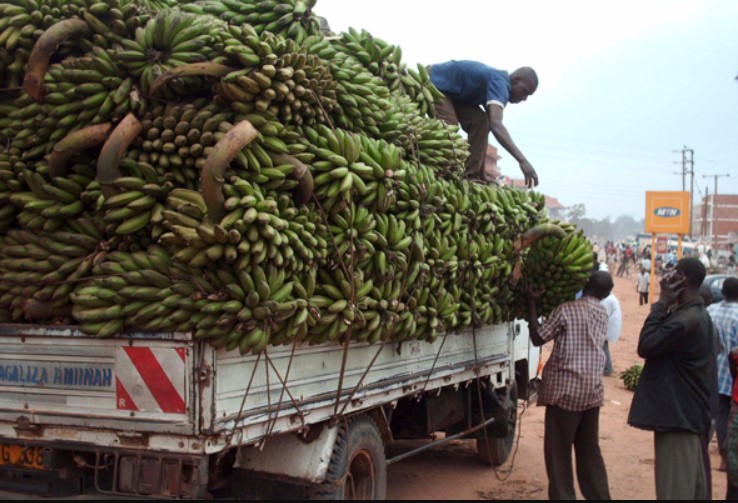
Vendors offload matooke from a truck in Kampala.

What you need to know:
- To moderate the volatile market, the government has stepped up centralized procurement through the state-owned Uganda National Oil Company (UNOC). By leveraging its partnership with global energy trader Vitol, UNOC has diversified its supply sources to include West Africa, Europe, India, and the Americas to guarantee uninterrupted fuel availability.
A sharp spike in energy, fuel, and utility costs is putting renewed pressure on Ugandan households, offsetting the relief brought about by falling food prices.
According to the latest monthly economic performance report released by the Ministry of Finance, Planning and Economic Development, annual Energy, Fuel, and Utilities (EFU) inflation accelerated sharply to 6.1 percent in April 2026, up from 4.1 percent in March.
The report highlights a steep inflationary trajectory since the beginning of the year.
EFU inflation stood at just 1.7 percent in January, before climbing to 2.7 percent in February, 4.1 percent in March, and ultimately hitting 6.1 percent in April. The Ministry primarily attributed this aggressive surge to rising domestic pump prices and a substantial increase in the cost of charcoal, a primary cooking fuel for many urban households.


The Ministry of Finance noted that domestic fuel prices have climbed as international markets react to ongoing global geopolitical tensions. Currently, the average pump price for a litre of petrol ranges around Shs 6,250, while diesel is priced at Shs 6,105. While these rates are relatively stable compared to recent weeks, they represent a harsh reality for motorists, sitting nearly Shs 2,000 higher than the prices recorded just two months prior in February.
Speaking on the developments, Ms. Irene Bateebe, the Permanent Secretary of the Ministry of Energy and Mineral Development, explained that the retail hikes reflect broader global shocks.
“The recent increases in retail pump prices are driven by supply constraints, higher importation costs, exchange rate fluctuations, and intense regional demand pressures,” Bateebe said.
She further revealed that Uganda’s comparatively lower fuel prices had triggered cross-border demand, temporarily straining fuel availability in border districts as buyers from neighboring nations crossed over to purchase cheaper Ugandan stock. However, she assured the public that supply lines have since stabilized.
While Uganda's fuel market remains liberalized—with prices independently set by Oil Marketing Companies (OMCs)—the government maintained that without strategic intervention, the impact on local consumers would have been far more severe.
To moderate the volatile market, the government has stepped up centralized procurement through the state-owned Uganda National Oil Company (UNOC). By leveraging its partnership with global energy trader Vitol, UNOC has diversified its supply sources to include West Africa, Europe, India, and the Americas to guarantee uninterrupted fuel availability.
Additionally, the government is actively managing its strategic fuel reserves at the Jinja Storage Terminal to prevent localized shortages. Officials emphasize that these combined efforts have successfully kept Uganda’s pump prices lower than those of several other East African Community (EAC) member states.
To permanently reduce Uganda’s vulnerability to international oil market volatility, the Ministry of Energy is aggressively pushing forward with major infrastructure project with the Jinja Storage Terminal being expanded from 30 million to 40 million litres. Meanwhile, the privately-backed Mahathi Infra Terminal on Lake Victoria provides 70 million litres of capacity to improve regional water-borne logistics.
Construction is progressing on a massive 320-million-litre facility in Mpigi District, which will eventually connect to the national refined products network and the planned Hoima refinery pipeline.
Located in Kabaale, Hoima District, this $4 billion, 60,000 barrels-per-day facility will feature a domestic refinery, a 211-kilometer multi-products pipeline, and vast storage infrastructure.
Once operational, the Hoima refinery is expected to radically eliminate Uganda's total dependence on imported refined petroleum products, while boosting domestic industries like petrochemicals, fertilizer manufacturing, and Liquefied Petroleum Gas (LPG) development.
Furthermore, Bateebe announced that the government has finalized the National Petroleum Policy 2025, replacing the outdated 2008 framework to align the sector with commercialization and the global energy transition. New LPG safety regulations have also been enacted ahead of the Third Petroleum Exploration Licensing Round scheduled for the 2026/2027 financial year.
Amidst the energy crunch, Ugandan consumers found vital relief at the marketplace. Annual food crop inflation eased to 0.6 percent in April down from 1.0 percent in March, driven by favorable weather conditions that boosted seasonal harvests and improved nationwide supply chains.
The Ministry of Finance concluded that this mixed economic picture means that while households are paying significantly more to commute and power their homes, the bounty from the current harvest season is providing much-needed breathing room on essential food staples.