Prime
MUSEVENI 24 YEARS LATER: Ours is not a mere change of guard; it is a fundamental change
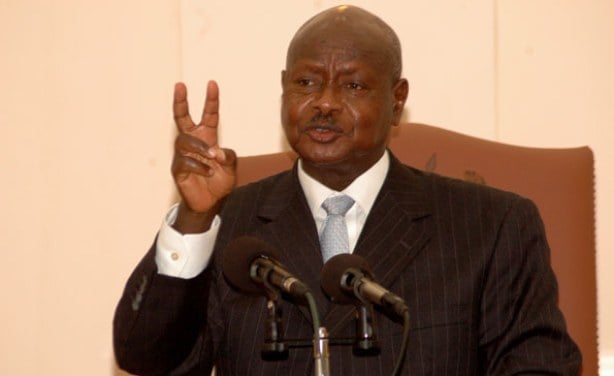
President Museveni.
At his swearing-in as President after the National Resistance Army troops had overrun Kampala, Yoweri Museveni, gave an address on the steps of Parliament on January 29, 1986, where he made the famous remark about theirs not being a mere change of guard, but a fundamental change. Daily Monitor retrieves this speech from the archives and also profiles some of Mr Museveni’s famous quotes.
NO ONE should think that what is happening today is a mere change of guard: it is a fundamental change in the politics of our country. In Africa, we have seen so many changes that change, as such, is nothing short of mere turmoil. We have had one group getting rid of another one, only for it to turn out to be worse than the group it displaced. Please do not count us in that group of people: the National Resistance Movement is a clear-headed movement with clear objectives and a good membership.
Of course, we may have some bad elements amongst us - this is because we are part and parcel to Ugandan society as it is, and we may, therefore, not be able completely to guard against infiltration by wrong elements.
It is, however, our deliberate policy to ensure that we uplift the quality of politics in our country. We are quite different from the previous people in power who encouraged evil instead of trying to fight it.
You may not be familiar with our programme, since you did not have access to it while we were in the bush so I shall outline a few of its salient points;
The first point in our programme is the restoration of democracy. The people of Africa-the people of Uganda-are entitled to democratic government. It is not a favour from any government: it is the right of the people of Africa to have democratic government. The sovereign power in the land must be the population, not the government. The government should not be the master, but the servant of the people.
In our liberated zones, the first thing we started with was the election of village Resistance Committees. My mother, for instance, cannot go to parliament; but she can, surely, become a member of a committee so that she, too, can make her views heard. We have, therefore, set up village, muluka, gombolola and district committees.
Later we shall set up a national parliament directly elected by the people. This way we shall have both committee and parliamentary democracy. We don’t want to elect people who will change sides once they are in parliament. If you want to change sides, you must go back and seek the mandate of the people who elected you.
Democracy
Some of these points are for the future, but right now I want to emphasise that the first point in our political programme is democracy for the people of Uganda. It is a birthright to which all the people of Uganda are entitled.
The committees we have set up in these zones have a lot of power. You cannot, for instance, join the army or the police without being cleared by the village committee.
You must get a recommendation from the people in your village to say that you are not a rogue.
Hence, the soldiers who are joining us from other armies will have to be referred back to their villages for recommendation. The same applies to the police.
Suppose, for instance, that we want to recruit some 500 soldiers from the District of Rakai and say 10,000 youths in the area apply to join. If 5,000 of those are cleared by their area committees as people of good character, the selecting military team will choose the most physically fit from among those, and we shall end up with an army that is both of good character and in good physical condition. This is an example of some of the work to be done by the village committees.
Another important aspect of the committees is that they should serve as a citizens’ intelligence system. If I go to address a rally in Semuto, Rape-ka or Nakaseke, I shall first meet the muluka and gombolola committees in the area. They will tell me whether the muluka chiefs are thieves, or the hospital personnel are selling drugs, or whether there are soldiers in the area who are misbehaving. They are thus able to act as watchdogs for the population and guard against the misuse of power.
The second point in our programme is the security of person and property. Every person in Uganda must be absolutely secure to live wherever he or she wishes. Any individual or any group of persons who threatens the security of our people must be smashed without mercy.
Security
The people of Uganda should only die from natural causes that are beyond our control, but not at the hands of fellow citizens who continue to walk the length and breadth of our land freely.
When we were in Nairobi during the peace talks, it was a very painful experience sitting in a room with criminals across the table. 1 was advised that being a leader, you have to be diplomatic.
This prompted me to ask: “But does diplomacy apply to criminals as well?” to which the answer was, “Yes”. I saw then that the whole process was a farce. We tried peacefully to push the case that the Amin elements, and people like Bazilio Okello, who had killed people in broad daylight, must be excluded from government.
Our voice, however, was a lonely one because there were so many pressures from the International community which is interested only in trade. They do not care how many skeletons we have in Uganda: all they care about is for the road to be opened so that their goods can have free passage. We, therefore, made our position very clear: we were not going to take part in any government which included and Involved criminals. Unfortunately these people believed they had tricked us. Tito Okello, for instance, came back saying that my signing the agreement showed that they had removed the teeth from the salambwa (poisonous snake).
Our position, however, has always been very clear. If you play tricks with us, we shall play tricks with you; if you are honest with us, we shall be honest with you; if you are violent against us, we shall be violent against you. We are people who pay others in their own currency and we never use cowardly tactics. When I was in the bush, I had a lot of pressure from people who said that we should assassinate people like Obote, Muwanga and Bazilio.
Against assassination
I disagreed because I argued that when you assassinate people like that, you turn them into martyrs and heroes. What you need is to develop enough strength to enable you to sweep that kind of garbage to where it belongs: on the dungheap of history. Why should anybody bother to kill small people like Bazilio? You may kill Bazilio Okello but you will be left with many other Bazilios.
Therefore, the security of the people of Uganda is their right and not a favour bestowed by any regime. No regime has a right to kill any citizen of this country, or to beat any citizen at a road block. We make it clear to our soldiers that if they abuse any citizen, the punishment they will receive will teach them a lesson. As for killing people - if you kill a citizen, you yourself will be killed.
During our struggle, we executed five soldiers of the National Resistance Army for killing people in Bulemezi, Ngoma and Fort Portal. One of these soldiers had killed a doctor in order to steal his money.
What, on the other hand, has been happening in Kampala? Recently, people were massacred in Luwero and a high-powered delegation was sent there: you know these so-called high-powered delegations led by Excellencies and honourables, etc. Personally, I do not like being called ‘Excellency’.
People in Bulemezi call me Yoweri or Mzee wa Kazi. Now, these Excellencies, and honourable ministers and high-ranking military personnel, and what-have-you went to Luwero. Can you imagine what they did? We were told that they had transferred the person who had killed the people in Luwero to another station! Can you imagine? Someone kills 100, 50 or even two people and you say you have transferred him to another area? It was suggested that the solution to some of our problems would be for Kampala to be completely demilitarized.
Disciplining soldiers
So I asked: “Where are you going to take these criminal soldiers? Even if you take them to a national park they will kill the animals there!” The solution, therefore, is to put criminal soldiers where they belong: in prison.
The third point in our programme is the question of the unity of our country. Past regimes have used sectarianism to divide people along religious and tribal lines. But why should religion be considered a political matter? Religious matters are between you and your god. Politics is about the provision of roads, water, drugs, in hospitals and schools for children.
Case for unity
Take the road from here, Parliament Buildings, to Republic House. This road is so bad that if a pregnant woman travels on it, I am sure she will have a miscarriage! Now, does that road harm only Catholics and spare Protestants? Is it a bad road only for Moslems and not for Christians, or for Acholis and not for Baganda? That road is bad and it is bad for everyone.
All the users of that road should have one common aspiration: to have it repaired. How do you become divided on the basis of religion or tribe if your interests, problems and aspirations are similar? Don’t you see that people who divide you are only using you for their own interests not connected with that road?
They are simply opportunists who have no programme and all they do is work on cheap platforms of division because they have nothing constructive to offer the people.
Our Movement is strong because it has solved the problem of division: we do not tolerate religious and tribal divisions in our Movement, or divisions along party lines such as UPC, DP, UPM and the like. Everyone is welcome on an equal basis. That is why you find that when our army goes to Buganda, the people there call it amagye gaffe, abaana baffe. When it goes to the West, it Is amahe gaitu, abaana baitu: which means that wherever the NRA goes, it is called ‘our army, our children’. Recently, Buloba was captured by our army, and the commander in charge of the group was an officer called Okecho. He comes from Pakwach in West Nile.
Therefore, the so-called division between the north and south is only in people’s heads. Those who are still hoping to use it are going to be disappointed. They ought to dig a large grave for such aspirations and bury them. Ma-sindi was captured by our soldiers led by Peter Kerim: he, too, is from West Nile. Dr. Ronald Batta here, who is from Madi, has been our Director of Medical Services for all these years in the bush.
‘Angry’ Obote
Obote tried to propagate the idea that there was a division between the Bantus and the Nilotics and that if the Bantus took over, the Nilotics would be wiped out. We have, however exposed him. Whenever, we captured soldiers from Ac noli, Lango and elsewhere, we would treat them well and then release them.
Obote would be surprised and he would ask: “Were you really captured? Did you see Museveni? Were you really not beaten?” Once we captured the police commander of Masindi, a man called Gala.
I talked to him and another man called Epigo, also from Masindi. When we released them and Epigo got back to Obote, Obote did not like what Epigo had to say: that the National Resistance Army was not a tribal army as the Obote government had been trying to make out. So Obote locked Epigo up in Luzira Maximum Security Prison because he did not want to hear the truth about our Movement and Army.
There is, in philosophy, something called obscurantism, a phenomenon where ideas are deliberately obscured so that what is false appears to be true and vice versa.
We in the NRM are not interested in the politics of obscurantism: we want to get to the heart of the matter and find out what the problem is. Being a leader is like being a medical doctor. A medical doctor must diagnose his patient’s disease before he can prescribe treatment.
Similarly, a political leader must diagnose correctly the ills of society. A doctor who does not diagnose his patient’s disease adequately is nothing but a quack.
In politics we have also got quacks - and Uganda has had a lot of political quacks over the past two decades or so.
I also want to talk about co-operation with other countries, especially in our region. One of our weaknesses in Africa is a small market because we don’t have enough people to consume what we produce.
Regional cooperation
Originally we had an East African market but it was messed up by the Excellencies and Honorable ministers. It will be a cardinal point in our programme to ensure that we encourage co-operation in economic matters, especially in transport and communication within the East African region.
This will enable us to develop this area. We want our people to be able to afford shoes. The Honorable Excellency who is going to the United Nations in executive jets, but has a population at home of 90 per cent walking barefoot, is nothing but a pathetic spectacle.
Yet this Excellency may be busy trying to compete with Reagan and Gorbachev to show them that he, too, is an Excellency. These are some of the points in our political programme. As time goes on, we shall expand more on them.
Last appeal
To conclude, I am appealing to those people who are trying to resist us to come and join us because they will be integrated. They should not waste their time trying to fight us because they cannot defeat us.
If they could not defeat us when there were just 27 of us with 27 guns, how can they defeat this army which you saw here?
They cannot defeat us, first of all, because we have a correct line in politics which attracts everyone. Secondly, we have a correct line of organisation. Thirdly, our tactics are correct.
We have never made a mistake either in strategy or tactical calculation. I am, therefore, appealing to these people not to spill more blood, especially of the young men who are being misled by older people who should know better.