I promote farming to get people out of poverty; Gilbert Bukenya
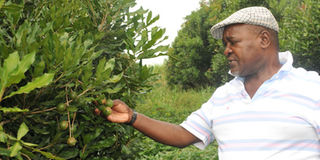
Macadamia nuts, pine trees and tropical apples are among the various crops that are grown on Prof Bukenya’s farms. In addition to crops, he is engaged in dairy cattle, fish and poultry, among others. Photo by Faiswal Kasirye.
What you need to know:
Following the success of Upland rice that Prof Gilbert Bukenya promoted throughout the country while he was Vice President, he is planning a similar exercise in the near future. He talked to Dorothy Nakaweesi about it and more.
Out of keenness to see Ugandans get ways out of poverty through agriculture, in 2003, I started by planting Nerica Upland rice to see how it would perform. I got the inspiration while on a trip to Cameroon in West Africa. I planted the initial rice seeds on less than half an acre at my farm in Lwantama-Kakiri, Wakiso District.
Growing upland rice was an experiment, that is why I started by planting the first crop in my constituency. After the successful implementation of the project in Wakiso, within five years, the crop had spread to various parts of the country to places as far as Bwambara in Rukungiri District.
Upland rice has received positive reception because it ensures food security and is a source of income to those who grow it. There is no reason why Uganda should import rice from Asia. Asia’s simplest way of making money has been through selling rice to Africa. I saw this as an opportunity to get people out of poverty and I am glad that Upland rice has spread countrywide.


I toured almost the entire country promoting the crop. Later, I had to let the Ministry of Agriculture take it up from there.
Innovation
After that, I turned my focus to other similar innovations. For the last three years, I have been multiplying tropical apples, hibiscus and macadamia. I believe like upland rice, these three crops will help change the lives of Ugandans, especially those living on fragmented land.
During one of my trips to California, in the US, I saw apples which can survive in the tropics. I knew this would do well in Uganda and I brought the seedlings. For macadamia, I got the seedlings from Hawaii, which is also part of US, and for the hibiscus, the seedlings came from South Sudan.
I have already set up three demonstration plots at my farm for the three crops. I believe once these innovations are successful, I will then transfer the skills to the people and move on to something else. The beauty about these new crops, is that they can be grown by people living on small pieces of land because they are high yielding.
Tropical apple
In Uganda, the apples consumed are either imported from Kenya, South Africa and a few are grown in the highlands of Kabale in western Uganda. The bigger part of Uganda being in the tropics, no one would believe or think about growing the apples. The good news is that the apples can grow in a tropical environment and more so in your backyard.
I got this concept from the California Research Centre about nine months ago and used the same ground, where upland rice was first experimented. Through grafting, scientists got a strain that can grow in humid areas—especially in places where the land is fragmented.
According to research, each tropical apple tree, on average, bears 400 fruits. Therefore, with two seasons in Uganda, this number of fruits doubles to 800.
And if each fruit is sold at Shs200; a farmer gets Shs160,000 from one tree in both seasons. This means someone owning a plot of land, which is less than an acre can be able to plant 100 trees. Annually, a farmer will have an income of about Shs16m.
Once the apple tree is planted, it takes one and half years to start fruiting. With good care and management, the apple tree’s life span is long-term. When planting, the apple tree has to get a rooting stock –it is then grafted.
At the root of each tree, sand is spread around it, this helps the plant to bring new rooting stocks which are then removed and planted elsewhere and this cycle continues. Tropical apples have been a success in Zambia-the country has the biggest component of it.
Macadamia
I have planted about 40 trees of macadamia and I am now harvesting the nuts. Macadamia is a revolution for Africa; if you go to a place like Nakumatt Supermarket and buy a pack of roasted macadamia nuts, it will cost you Shs12,000.
Each kilo costs about $30 (Shs80,000); if someone has about eight trees he or she would be very rich. The tree takes three and half years –once the fruit raptures, it is ready. The tastiest nut is macadamia fruit and it is the most expensive in the world.
The reason why I chose this path of business was because with agriculture, you cannot go wrong. I also wanted to create a difference in the lives of many Ugandans. This is what government should promote and invest money before the country turns into an importing food nation like Nigeria.
With fragmented land, we can come up with new innovations and because of the passion for agriculture I have tested out several crops to later extend the skills to other people.
I have been practicing agriculture since 2003, it is been 10 years down the road. I am a proud mixed farmer.
Other activities
I am involved in poultry production, dairy cattle and goat rearing, I have a 40-acre coffee plantation, I grow different varieties of vegetables, I have a plantation of matooke, I grow maize, mangoes, pineapples, avocados and lemon grass, among others. I am also involved in aquaculture (cage fish farming, mainly dealing in Tilapia and catfish). I also plant pine trees at his farm.
I mainly export some of the produce to Kenya and Rwanda and also supply to the local market, within my constituency and to Kampala’s supermarkets. On average, all these activities bring me an annual profit of about Shs400m.
I use my farm as a learning ground for people in my constituency and other Ugandans who are interested in making their lives better. I give people knowledge on how to invest in their land: many have become successful.
At the farm, I employ more than 50 people, both on permanent and casual basis, who help me do the work.
Challenges
Mechanisation is one big challenge that I experience and this is not only me but other farmers as well. You produce and cannot add value and, at the end of the day, you sell your produce at low prices.
Getting the right seeds is the other challenge I experience—some people have tried to produce seeds locally but their germination rate is still questionable and this affects productivity. In countries like Kenya, for one to be certified, they must have produced seeds with an 80 per cent germination rate.
Our challenge here is that when the seed industry was privatised, it caused a problem because everyone is producing but standards are not followed.
The other challenge I experience is lack of storage facilities for some produce like maize, when it is a bumper harvest. If it is not processed to the next stage, I will either sell it cheaply or risk suffering losses.
Advice
In my opinion, the government should concentrate and give priority to agriculture more because it supports the economy. Everybody is excited about the discovery of oil, but we should not forget about agriculture.
If we do, we shall have committed a very big “sin” like Nigeria, which once had a vibrant agriculture sector but when oil was discovered; they abandoned food production and now it is the leading importer of food.
In a bid to bring this issue forward, I plan to propose to Parliament that at least 30 per cent of the oil revenues be set aside to improve the country’s agriculture sector.
We must promote the storage of food, if 80 per cent of work in a year is spent on promoting agriculture, Uganda would be very far [in development terms] but 90 per cent of this valuable time, people spend talking without action.
Leaders should acquire such knowledge and disseminate it to their people, for instance, if the whole of Rakai concentrated on macadamia, processed and roasted the nuts for export, Uganda would be very far in development.