Otunnu abandons IPC, rallies Ugandans to join movement for change
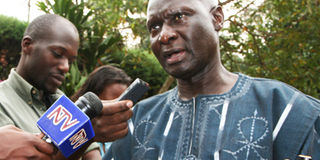
Uganda People’s Congress president Olara Otunnu during the press briefing. PHOTO BY PARISA AZADI
Uganda People’s Congress president Olara Otunnu on Monday appealed to all Ugandans to embrace the idea of what he called a National Social Movement to ‘champion fight for democracy’ in the country.
Mr Otunnu was speaking at a press conference at Christ the King Church in Kampala where he officially declared the exit of UPC from the Inter-Party Cooperation(IPC).
The former UN diplomat said the country is yearning for a change of regime and yet the current electoral process being organised on Mr Museveni’s terms is out to lead to massive fraud and rigging of elections to maintain the status quo.

He thus said Uganda’s historic moment to get a new regime calls for a singular response – building a national social movement that will insist, among other demands, on genuine free and fair elections, and truth-telling and accountability.
“Together we must now begin to chart a new path leading to a new Uganda, with a new national compact,” he said.
Mr Otunnu said national social movement aims to bring together democracy-seeking political parties, civil society, religious organisations, the business community, workers, pressure groups, youth and women organisations.
OTUNNU'S STATEMENT IN FULL
My fellow Ugandans, today I address you on the all-important issue and theme of: Free and fair elections -- A fork in the road.
Our country is engaged in a historic struggle to regain our freedom, dignity and human rights. In this struggle, there are times when we have to make very tough choices. In so doing, we must retain our resolve and clarity of purpose.
Today, we are at such a moment. As you know, we in Uganda Peoples Congress (UPC) have been engaged in a difficult dialogue, one of great import to the country, with our Inter-Party Cooperation (IPC) partners.
There are three major concerns that we have placed before our IPC partners.
Identity and method of work of IPC
The first issue concerns the identity and method of work of IPC. IPC is not a new political party that has emerged on the political landscape. Neither is it a merger of the political parties that constitute it. We must therefore do everything to avoid giving this erroneous impression when presenting IPC to the electorate.
IPC is an umbrella of independent political parties, with distinct ideological orientations, and autonomous national and local structures.
We in UPC believe that strong, well-defined and firmly rooted political parties are the best pillars for building and guaranteeing democracy in Uganda. We want to see political parties flourish, not wither.
Moreover, in offering an alternative to the NRM modus operandi for governance, it is particularly incumbent on us in IPC to set a clear above-board example of transparent and democratic practice in our activities. Over a period of time, we have shared with our IPC partners our specific concerns in this respect.
Truth-telling and accountability
The second issue of great concern to us relates to truth-telling and accountability. There have been major traumatic episodes in our recent history. I have in mind particularly the massacre of 33 unarmed demonstrators in the streets of Kampala on 10 & 11 September, 2009; atrocities committed during the war in the Luwero triangle (1981-1985); the massacre of Muslims in Mbarara (1979); the Ombachi massacre in West Nile (1981); and the genocide committed in northern Uganda (1986-2008).
These episodes remain deep and festering wounds on the side of Uganda’s body politic. UPC has insisted that we must undertake independent investigations about what happened in each of these cases and assign responsibilities for the atrocities and crimes in question.
Our preoccupation is not retribution or revenge. Far from it. No amount of retribution can compensate for the unbelievable agony and suffering visited upon these communities. This is about reconciliation and healing in our land.
I want to see us, as a people, climb to the top of a certain hill - - the hill of reconciliation and forgiveness. There to embrace in humility and prayerful forgiveness. There to wipe off the tears of the communities that have long been hurting in silent, unacknowledged agony.
But the path to the top of that hill necessarily passes through the valley of sorrow, of reckoning and of acknowledgement. We cannot leapfrog our way from the land of impunity, where we are stuck today, on to that hill of reconciliation and healing. Our country cannot turn a new page, our country cannot experience healing without walking through this valley. It is simply not possible.
For what then shall we reconcile about, if the facts about the crimes and atrocities remain deeply concealed? And who shall we reconcile with, if there is no assignment of responsibility; if there is no acknowledgement of culpability?
When I have persisted in the call for truth-telling and accountability concerning these dark chapters in our history, the Museveni regime has responded with fury: We shall crush you! We shall arrest you! And sure enough a raft of charges came tumbling in: criminal libel; promoting sectarianism; sedition; and arrest warrant. I must assure the people of Uganda that, on this matter, no amount of persecution and terror will silence our voice.
It is now very clear that the Museveni regime will fight tooth-and-nail to ensure absolute concealment and silence. We are concerned that our partners in IPC have been conspicuously silent on this capital issue. We should like the question of truth- telling and accountability to move to centre stage of our common agenda. We must break this conspiracy of silence.
Genuinely free and fair elections.
The third issue, which is our core preoccupation and deal-breaker, concerns free and fair elections.
Our country is engaged in a historic struggle to regain our freedom, dignity and human rights. At the heart of this struggle is our non-negotiable demand for genuinely free and fair elections in 2011. UPC finds itself at the point of a fork in the road. We must make a clear choice on the way forward. We cannot equivocate. Neither can we take refugee in the middle ground.
This fork in the road has its historical analogue in the African independence struggles of the late 1950s and the early 1960s. The opposing views then were between the advocates of “Independence Now!” and the proponents of “Independence as soon as possible!”. Like Kwame Nkrumah’s CPP, Mwalimu Julius Nyerere’s TANU, Kenneth Kaunda’s UNIP, Jawaharlal Nehru’s Congress Party, and Ignatius Musazi’s UNC, before us, UPC says “Free and fair elections Now!”
UPC has made its choice. We shall remain firm and faithful to the common position we unanimously adopted in IPC, concerning free and fair elections.
For the sake of clarity, let me reiterate the four key components of this collective IPC position.
- We are absolutely committed to ensure that the elections of 2011 are free and fair. This is a non-negotiable demand and objective. The people of Uganda, like citizens in other countries, deserve no less.
- We reject the Museveni/Kigunddu Electoral Commission, because that Commission is aligned with the NRM regime, and because that Commission has been the primary instrument of electoral fraud and rigging on behalf of the regime. Specifically, our rejection means non-recognition, non-cooperation and non-participation. It is patently clear that the Museveni/Kiggundu Commission is incapable of delivering free and fair elections for the people of Uganda. That is why we absolutely insist on a new and independent Electoral Commission. The new commission must be constituted on the basis of a new modality agreed upon by all stakeholders.
- We reject the voters’ register compiled by the Museveni/Kiggundu Commission. That register is fatally flawed, because of manipulation and fraud by that Commission, compounded by its incompetence. That register cannot therefore be the basis for organising free and fair elections. The register of voters needs to be overhauled and rectified by a new and independent Electoral Commission.
- The Museveni/Kiggundu electoral roadmap will inevitably lead to fraudulent and rigged elections, because that roadmap is constructed on and extends from deeply flawed foundational blocks, as exemplified by a partial Electoral Commission and a fraudulent voters’ register. To arrive at our chosen destination, namely free and fair elections, the flawed foundational blocks must be reset right and the roadmap must be recharted accordingly.
IPC summit first announced to the country this clear-cut and unequivocal position on 19 May, 2010. IPC summit reaffirmed this position to the country as recently as 6 August 2010.
We are now deeply concerned that our partners in the IPC have retreated from this clear collective position. Their new message is: We shall continue to demand for free and fair elections; we shall continue to reject the Museveni/Kiggundu Electoral Commission as well as the fraudulent voters register; but, we shall participate in elections organised by the same Museveni/Kiggundu Electoral Commission, on the basis of the same fraudulent voters’ register. Our IPC partners are now saying: We shall participate, knowing full well that the elections are fraudulent and rigged.
This is the fork in the road. We cannot both reject and accept fraudulent elections. We must make a choice. In this connection, UPC extends its deep appreciation to the Episcopal Conference of the Catholic Church for its recent pastoral letter, in which it takes a clear stand in favour of genuinely free and fair elections, an independent Electoral Commission and clean voters’ register. We thank you for remaining faithful, in these trying times, to the Church’s prophetic mission to the people of God. From this podium, I urge other religious, civic and professional organisations to similarly assume their responsibility. Raise your voice! Please, raise your voice! In this moment of choice, you cannot remain silent; you cannot stand in the middle.
Why is UPC so dismayed by the change of position on the part of our IPC partners?
- IPC’s reason-for-being is our unequivocal demand for genuinely free and fair elections. That is our common IPC project. This is the glue that unites us. Without that project our unity is hollow and bereft of a substantive agenda.
- To say we both reject and accept the Museveni/Kiggundu Electoral Commission and the fraudulent voters’ registry, is a retreat from and a complete contradiction of the position we unanimously adopted.
- The people of Uganda are yearning for a change of regime. The current electoral process is being organised on Mr. Museveni’s terms. As in the past, it will inevitably lead to massive fraud and rigging. Regime change will never happen under these fraudulent and rigged elections. After 25 years of fraud and terror, this particular leopard is not about to change its spots.
- The spectre of catastrophe hangs ominously over our land. Below a seemingly normal situation, the country is teetering on the brink of a political explosion, borne of more than two decades of entrenched repression, humiliating impoverishment, staggering corruption, nepotism, repeated electoral fraud and impunity. It would be a major historical blunder to misread the current situation in the country. The last hopes of the Ugandan people are now pegged on the 2011 elections. Genuinely free and fair elections in 2011 provide the last window to avert a looming national catastrophe. This is, by far, the most effective preventive action for Uganda.
- Finally, to say we reject as well as accept the Museveni/Kiggundu Electoral Commission and the current voters’ registry, sends a very disturbing and confusing message to the electorate. So I ask: What have the people been agitating for? For what have they been facing the Kiboko Squad for? And now, what shall we tell them to fight for?
A word about all this talk about boycott. Boycott is not in UPC’s vocabulary. UPC is preparing and mobilizing for the elections of 2011.We are not advocating boycott or no-elections. Our demand and insistence is that the elections that must take place in 2011, must be free and fair.
The choice before the Ugandan electorate is not between fraudulent elections and boycott; that is a false choice. Boycott suggests that the people of Uganda will be passive bystanders, taking no initiatives, waiting for Mr. Museveni to impose his fait accompli on the country. The real choice is between participating in fraudulent elections and participating in genuinely free and fair elections. Mr. Museveni is working to impose the former.
Ugandan people must mobilize, demand and create a different reality that will ensure the latter outcome. We must be the agents of shaping this destiny. We must draw a line in the sand on this issue. This project will turn on the choice and resolve of Ugandan people. We must settle the issue of free and fair elections in Uganda once and for all. I must tell you this. I have not the slightest doubt in my mind that we shall accomplish this in the year 2011; we simply must remain steadfast, firm and resolute.
UPC insists that elections in Uganda must be subject to and judged by the same internationally accepted standards of electoral probity applied elsewhere in the world. We therefore strongly condemn the scandalous exceptionalism which has been accorded the Museveni regime in the past.
UPC addresses a special message to Uganda’s international partners and the broader international community. We strongly urge them to remain faithful to and consistent with the values and standards they espouse; these norms and principles we strongly share and support. In this connection, we are deeply dismayed that, in the past, Uganda’s international partners have exhibited astonishing double-standards and exceptionalism in relation to the conduct of the Museveni regime.
I should like to stress again that what UPC insists on and is campaigning for, is genuinely free and fair elections organised by an independent Electoral Commission and based on a clean and verifiable register of voters.
UPC’s participation in IPC
UPC is an architect and founder member of IPC. The commitment and contribution of UPC to IPC is everywhere in evidence. Indeed some of the most important ideas and initiatives adopted by IPC were proposed by UPC. I have personally, over many years now, been a strong advocate of the IPC project and a united front among democracy-seeking political parties.
I wish, on this occasion, to express my very warm tribute to CP, FDC, JEEMA, SDP, and their leaders. I honour their valiant contributions to the struggle for democracy in Uganda.
It is therefore with a heavy heart and much sadness that, after very careful review, have to say that UPC is unable to continue working within the IPC project and process.
UPC shall welcome the opportunity of working with CP, JEEMA, SDP and FDC within the broader framework of a national social movement to build a democratic and just society in our country.
National social movement
This historic moment calls for a singular response: building a national social movement that will insist, among its important demands, on genuinely free and fair elections, and truth-telling and accountability. Together we must now begin to chart a new path leading to a new Uganda, with a new national compact.
This is not about UPC. This is not a UPC project.
The project we are proposing to the people of Uganda today is larger than UPC; indeed it is larger than the political parties. It concerns and embraces Ugandans of all hues, orientations and affiliations. What unites us is a common hunger for freedom, dignity, reconciliation and democracy in our land.
The national social movement therefore aims to bring together democracy-seeking political parties, civil society, religious organisations, the business community, workers, pressure groups, youth and women organisations. This will be a citizens’ struggle.
We have embarked on a journey of immense importance. The future of our country hangs in the balance. In this situation, our patriotic duty is to take charge and shape our own destiny under a national social movement.
Fellow Ugandans, this is our country. And yet, we have been reduced to subjects, subjugated in our own land. The people of Uganda are being held hostage by a politico-military clique.
It is time therefore that we, the people of Uganda, behaved as the owners of this country, not squatters or refugees in our own land.
We Must Take Back Our Country! We must regain control of our country from those who have hijacked it for the last 25 years.
Do not be afraid. Do not be afraid. This is our country.
I thank you very much for listening to this message.
Olara A. Otunnu
President of Uganda Peoples Congress
Delivered on 30th August, 2010, at Christ the King, Kampala